Showing posts with label Liberalism. Show all posts

Liberal Rhetoric 101: Overgeneralization

"Jihadists are right wing, as is the Tea Party!"

"The Ku Klux Klan is right wing, so is the Tea Party!"


 "Jesus taught to help the poor, ergo massive government welfare is Biblical!"

I'm guessing you've heard these claims, yes? It's all part of the liberal practice of taking a subject, looking at it from a great distance and boiling them down to a single common denominator while ignoring the dozens of other significant differences between the two. 

Lets consider the above three examples, shall we?

"Jihadists are right wing, as is the Tea Party!" and "The Ku Klux Klan is right wing, so is the Tea Party!" belong in the same explanation, so we'll treat them together.

The argument is based on the overgeneralized fact that "Radical Islam, the Ku Klux Klan and the Tea Party are on the political right.  While this is true, there is a matter of scale that is ignored by this comparison (please excuse the crudity of this model, it IS NOT to scale):
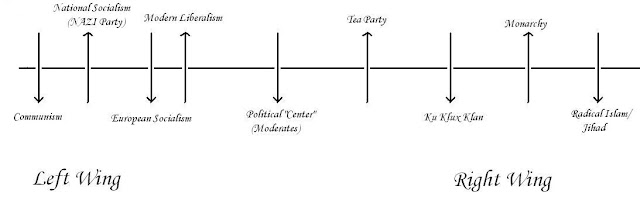


Note that while the Tea Party, the Ku Klux Klan and Radical Islam (as well as Monarchy, added in for comparison) are on the right wing of the spectrum. But no one who actually UNDERSTANDS the Tea Party (rather than the Drive-By Media's meme of the Tea Party) could consider it the same as the KKK or Radical Islam.

The Tea Party stands for equality and freedom FOR ALL, irregardless of race, in stark contrast to the KKK. It stands for a Constitutional Representative Republic, not a monarch, in stark contrast to monarchy. Finally, the Tea Party stands for the First Amendment's protection of Freedom of Religion, in stark contrast to Radical Islam.

The same would be true if a conservative were to attempt to claim that American Liberalism was the equivalent of Nazism (yes, the NAZI party was the NATIONAL SOCIALIST PARTY aka Left Wing, not right) or Communism. While these two factions do fall on the Left of the political spectrum, they are starkly farther to the Left than American Liberalism. (Comparing American Liberalism to European Socialism is a close comparison, however.)

Now for my third example:

"Jesus taught to help the poor, ergo massive government welfare is Biblical!"

While Christianity teaches us to help and provide for the poor, and liberals (at least claim) to try to help the poor using government welfare, there is a major difference in the way Jesus taught us to help the poor and how liberals try to help the poor. as I've pointed out over and over, there is no place in the Bible where Jesus said "Give your money to the government, and let the government help the poor." There's nowhere ANYWHERE in the Bible where God commands the government to care for the poor.

Even though liberals love to give the false impression that conservatives don't care about the poor, it's just not true. It's just that our plan to help the poor doesn't involve government. We believe in the Biblical model of individuals helping the poor either directly or through private charities.

All three of these examples show the liberal mentality of looking at things from only one angle, without looking at the nuances and specifics of the situations which make these supposed equivalencies not actual equivalencies.  To respond to these arguments is simple. Just take the time to break down the sheer ridiculousness of these comparisons by discussing the very nuances and specifics that make the equivalencies not equivalent.

*yes I AM quoting Back to the Future intentionally

Best of Biblical Conservatism: Letter Bag: The Difference Between Classical Liberalism and Modern Liberalism

Today, on Best of Biblical Conservatism, we have one of our most popular posts of all time!

I received an annonymous comment recently (for the sake of this post, we'll call that person Anny) on an a post on a post from a few weeks ago that I wanted to address it here.  The post was Dissecting the Liberal Talking Points: The Tea Party isn't Going Anywhere.  Here was the comment:

Liberalism: political doctrine that takes protecting and enhancing the freedom of the individual to be the central problem of politics. Liberals typically believe that government is necessary to protect individuals from being harmed by others; but they also recognize that government itself can pose a threat to liberty. As the revolutionary American pamphleteer Thomas Paine expressed it in Common Sense (1776), government is at best “a necessary evil.” Laws, judges, and police are needed to secure the individual’s life and liberty, but their coercive power may also be turned against him." (and it continues...)

The Tea Party is therefore liberal.

It's an interesting point, Anny.  It's wrong, but it's an interesting point. What this individual doesn't recognize is the difference between Classical liberalism and Modern liberalism.  The definition given above is the definition of Classical liberalism.  For those of you who aren't familiar with the term, Classical liberalism is focused on liberty.  It supports small government, individual rights, and the Constitution.  When our nation was founded, it was a relatively liberal idea, which is to say it was to the left of the monarchy.  (Conservatism is to the left of monarch too, by the way.)

You see, in 1776 and 1787, Anny, the ideas that the Declaration of Independence and Constitution espoused were radical.  They aren't radical anymore.  Our founders created these values new, now we conservatives try to maintain them.

Modern liberalism is not about small government, it's about big government.  It's not about individual freedom, it's about group conformity and government telling you what's good for you. Modern liberalism does not recognize that government can pose a threat to liberty...it sees government as the solution to problems. 

Modern liberalism is the polar opposite as Classical liberalism.  Classical liberalism is now known as conservatism.

What Anny said is a perfect example of an etymological fallacy.  For those of you who don't have degrees in Communications, an etymological fallacy "is a genetic fallacy that holds, erroneously, that the historical meaning of a word or phrase is necessarily similar to its actual present-day meaning." (For those of you from Palm Beach County, FL, that means believing that what a word originally meant is what it means today.)

Liberal doesn't mean what it meant in our founders day.  The same is true of many other words.  In 1776 if a man had a "gay kid" that meant they had a "happy baby goat."  Does it mean that now, Anny?  Of course not.  Few people think of a kid as a baby goat anymore, even though that is the origin of the word, and few people still think gay means happy.

In short, the Tea Party is Classically liberal, which is synonymous with Modern conservatism.  Sorry, Anny, but in our modern context the Tea Party is conservative.

Comments are always welcomed on posts, provided they are in line with the Rules for Comments.  Please note any comment may become subject matter for a future post, as my personal interest and news cycles require. 

Best of Biblical Conservatism: The Difference Between Classical Liberalism and Modern Liberalism

This week, since I'm on my annual Christmas vacation, I've been posting "The Best of Biblical Conservatism" with selections from 2011's ten most popular posts. Today's was originally posted on September 15, 2011.

I received an annonymous comment recently (for the sake of this post, we'll call that person Anny) on an a post on a post from a few weeks ago that I wanted to address it here.  The post was Dissecting the Liberal Talking Points: The Tea Party isn't Going Anywhere.  Here was the comment:

Liberalism: political doctrine that takes protecting and enhancing the freedom of the individual to be the central problem of politics. Liberals typically believe that government is necessary to protect individuals from being harmed by others; but they also recognize that government itself can pose a threat to liberty. As the revolutionary American pamphleteer Thomas Paine expressed it in Common Sense (1776), government is at best “a necessary evil.” Laws, judges, and police are needed to secure the individual’s life and liberty, but their coercive power may also be turned against him." (and it continues...)

The Tea Party is therefore liberal.

It's an interesting point, Anny.  It's wrong, but it's an interesting point. What this individual doesn't recognize is the difference between Classical liberalism and Modern liberalism.  The definition given above is the definition of Classical liberalism.  For those of you who aren't familiar with the term, Classical liberalism is focused on liberty.  It supports small government, individual rights, and the Constitution.  When our nation was founded, it was a relatively liberal idea, which is to say it was to the left of the monarchy.  (Conservatism is to the left of monarch too, by the way.)

You see, in 1776 and 1787, Anny, the ideas that the Declaration of Independence and Constitution espoused were radical.  They aren't radical anymore.  Our founders created these values new, now we conservatives try to maintain them.

Modern liberalism is not about small government, it's about big government.  It's not about individual freedom, it's about group conformity and government telling you what's good for you. Modern liberalism does not recognize that government can pose a threat to liberty...it sees government as the solution to problems. 

Modern liberalism is the polar opposite as Classical liberalism.  Classical liberalism is now known as conservatism.

What Anny said is a perfect example of an etymological fallacy.  For those of you who don't have degrees in Communications, an etymological fallacy "is a genetic fallacy that holds, erroneously, that the historical meaning of a word or phrase is necessarily similar to its actual present-day meaning." (For those of you from Palm Beach County, FL, that means believing that what a word originally meant is what it means today.)

Liberal doesn't mean what it meant in our founders day.  The same is true of many other words.  In 1776 if a man had a "gay kid" that meant they had a "happy baby goat."  Does it mean that now, Anny?  Of course not.  Few people think of a kid as a baby goat anymore, even though that is the origin of the word, and few people still think gay means happy.

In short, the Tea Party is Classically liberal, which is synonymous with Modern conservatism.  Sorry, Anny, but in our modern context the Tea Party is conservative.

Comments are always welcomed on posts, provided they are in line with the Rules for Comments.  Please note any comment may become subject matter for a future post, as my personal interest and news cycles require. 

Letter Bag: The Difference Between Classical Liberalism and Modern Liberalism

I received an annonymous comment recently (for the sake of this post, we'll call that person Anny) on an a post on a post from a few weeks ago that I wanted to address it here.  The post was Dissecting the Liberal Talking Points: The Tea Party isn't Going Anywhere.  Here was the comment:

Liberalism: political doctrine that takes protecting and enhancing the freedom of the individual to be the central problem of politics. Liberals typically believe that government is necessary to protect individuals from being harmed by others; but they also recognize that government itself can pose a threat to liberty. As the revolutionary American pamphleteer Thomas Paine expressed it in Common Sense (1776), government is at best “a necessary evil.” Laws, judges, and police are needed to secure the individual’s life and liberty, but their coercive power may also be turned against him." (and it continues...)

The Tea Party is therefore liberal.

It's an interesting point, Anny.  It's wrong, but it's an interesting point. What this individual doesn't recognize is the difference between Classical liberalism and Modern liberalism.  The definition given above is the definition of Classical liberalism.  For those of you who aren't familiar with the term, Classical liberalism is focused on liberty.  It supports small government, individual rights, and the Constitution.  When our nation was founded, it was a relatively liberal idea, which is to say it was to the left of the monarchy.  (Conservatism is to the left of monarch too, by the way.)

You see, in 1776 and 1787, Anny, the ideas that the Declaration of Independence and Constitution espoused were radical.  They aren't radical anymore.  Our founders created these values new, now we conservatives try to maintain them.

Modern liberalism is not about small government, it's about big government.  It's not about individual freedom, it's about group conformity and government telling you what's good for you. Modern liberalism does not recognize that government can pose a threat to liberty...it sees government as the solution to problems. 

Modern liberalism is the polar opposite as Classical liberalism.  Classical liberalism is now known as conservatism.

What Anny said is a perfect example of an etymological fallacy.  For those of you who don't have degrees in Communications, an etymological fallacy "is a genetic fallacy that holds, erroneously, that the historical meaning of a word or phrase is necessarily similar to its actual present-day meaning." (For those of you from Palm Beach County, FL, that means believing that what a word originally meant is what it means today.)

Liberal doesn't mean what it meant in our founders day.  The same is true of many other words.  In 1776 if a man had a "gay kid" that meant they had a "happy baby goat."  Does it mean that now, Anny?  Of course not.  Few people think of a kid as a baby goat anymore, even though that is the origin of the word, and few people still think gay means happy.

In short, the Tea Party is Classically liberal, which is synonymous with Modern conservatism.  Sorry, Anny, but in our modern context the Tea Party is conservative.

Comments are always welcomed on posts, provided they are in line with the Rules for Comments.  Please note any comment may become subject matter for a future post, as my personal interest and news cycles require.